





How To Start RAY-BAN META AI GLASSES: PROS, CONS, With Less Than $100
Explore Ray-Ban Meta AI glasses, including their smart features, camera, Meta AI, battery life, audio, pros and cons, privacy considerations, and what U.S. shoppers should know before buying.

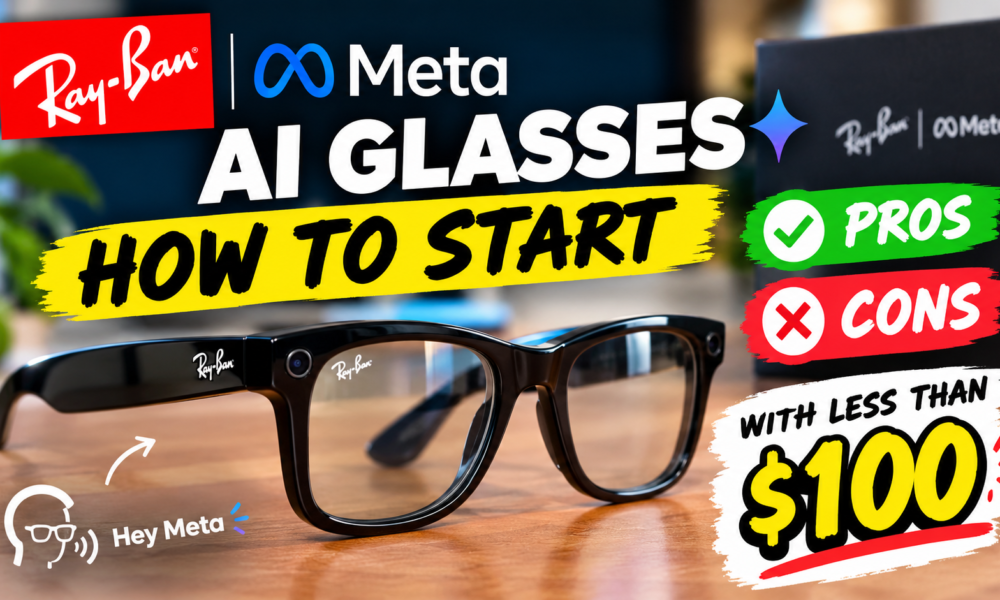
Smart glasses are no longer just a futuristic idea. The Ray-Ban Meta AI glasses combine the familiar style of traditional Ray-Ban eyewear with cameras, speakers, microphones and artificial intelligence. For people in the United States, they offer a hands-free way to capture photos, listen to music, make calls and interact with AI while keeping a smartphone in a pocket or bag.
Table Of Content
- What Are Ray-Ban Meta AI Glasses?
- Key Features
- 1. They Look Like Real Ray-Ban Glasses
- 2. Excellent Hands-Free Photography
- 3. Meta AI Adds Another Layer of Convenience
- 4. Built-In Audio Is Convenient
- 5. Good Option for Content Creators
- 6. Prescription Support
- 1. They Are Not Full Augmented-Reality Glasses
- 2. Battery Life Depends on How You Use Them
- 3. Smartphone and Internet Dependence
- 4. Privacy Can Be a Concern
- 5. AI Isn’t Always Perfect
- 6. They’re More Expensive Than Ordinary Sunglasses
- Pros
- Cons
- Who Should Consider Ray-Ban Meta?
- What About Privacy?
- The biggest strengths are
- The biggest limitations are
- Final Thoughts
But are smart glasses practical for everyday life? The answer depends on what you expect from them. Here is a closer look at their features, advantages and limitations.
What Are Ray-Ban Meta AI Glasses?
Ray-Ban Meta glasses are smart eyewear developed by Ray-Ban and Meta. Instead of using a conventional screen or projecting information directly into your field of vision, the glasses rely primarily on voice commands, audio and cameras.
The glasses can connect with a smartphone and the Meta AI app. Users can interact with Meta AI using voice commands, take pictures and videos, listen to audio, and communicate with other people.
The design is one of the product’s biggest selling points. They look much more like conventional Ray-Ban glasses than many other smart-glasses concepts.
Key Features
The Ray-Ban Meta platform includes several features designed for hands-free use:
- Built-in camera: Capture photos and videos from your point of view.
- Meta AI: Ask questions and interact with an AI assistant using your voice.
- Open-ear audio: Listen to music, podcasts and calls while remaining aware of your surroundings.
- Multiple microphones: Designed to pick up voice commands and support calls.
- Voice controls: Perform various functions without touching your phone.
- Hands-free calling: Make and receive calls through the glasses.
- Messaging: Supported messaging functions can be controlled using voice.
- Live streaming: Supported social platforms can allow compatible users to livestream.
- Prescription options: Selected Ray-Ban Meta models can be ordered with prescription lenses.
- Charging case: The glasses come with a dedicated case that also provides charging capability.
Pros of Ray-Ban Meta AI Glasses
1. They Look Like Real Ray-Ban Glasses
One of the biggest advantages is the relatively familiar design.
You don’t necessarily look like you’re wearing a piece of experimental technology. The glasses retain the recognizable appearance of Ray-Ban eyewear while incorporating smart hardware into the frame.
2. Excellent Hands-Free Photography
Taking a photo with a smartphone requires reaching into a pocket, unlocking the phone and opening the camera.
With Ray-Ban Meta, you can capture a moment from your natural point of view.
This can be especially useful for:
- Travel
- Family activities
- Walking and sightseeing
- Outdoor activities
- Cooking
- Creating social-media content
- Recording spontaneous moments
3. Meta AI Adds Another Layer of Convenience
Meta AI is one of the most interesting aspects of the glasses.
Instead of typing a question into your phone, you can speak to the assistant. Depending on the feature and availability, the glasses can also use their camera to help answer questions about things you’re looking at.
For example, users may ask AI to:
- Identify an object
- Explain something they are seeing
- Translate text
- Answer general questions
- Provide information while traveling
4. Built-In Audio Is Convenient
The open-ear speakers mean you don’t need to wear separate earbuds for many everyday audio tasks.
You can listen to music or take a call while keeping your ears relatively open to your environment.
5. Good Option for Content Creators
For creators, the glasses can provide a unique first-person perspective.
Instead of holding a phone or camera, a creator can record while using both hands. That can make certain activities easier to document.
6. Prescription Support
People who already need prescription eyewear don’t necessarily have to choose between their regular glasses and smart glasses. Prescription configurations are available for supported models and lenses.
Cons of Ray-Ban Meta AI Glasses
1. They Are Not Full Augmented-Reality Glasses
This is an important distinction.
Ray-Ban Meta glasses do not provide a conventional heads-up display showing maps, text or virtual objects in front of your eyes.
If you expect something similar to a science-fiction AR headset, these glasses may feel different from what you imagined.
2. Battery Life Depends on How You Use Them
Battery performance varies with usage.
Heavy camera recording, AI interactions, calls and other demanding features can consume power faster than simply wearing the glasses.
For someone who records frequently throughout the day, battery management is something to consider.
3. Smartphone and Internet Dependence
Many smart features rely on a connected smartphone, the Meta AI app and internet connectivity.
That means the glasses aren’t completely independent from your other technology.
4. Privacy Can Be a Concern
A camera mounted on someone’s face naturally raises privacy questions.
Although the glasses have an external capture indicator for certain recording functions, people around you may still feel uncomfortable being recorded.
Users should be especially careful in workplaces, schools, private businesses and other locations where photography or recording may be restricted.
5. AI Isn’t Always Perfect
Like other AI assistants, Meta AI can sometimes misunderstand a question or provide an incorrect or incomplete answer.
It is better viewed as a convenience tool rather than an unquestionable source of information.
6. They’re More Expensive Than Ordinary Sunglasses
Traditional sunglasses can be purchased for considerably less than smart glasses.
With Ray-Ban Meta, you’re paying for additional technology, including cameras, speakers, microphones, batteries and computing-related features.
Ray-Ban Meta AI Glasses: Pros and Cons at a Glance
Pros
- Stylish, familiar Ray-Ban design
- Hands-free photos and videos
- Voice-controlled AI
- Built-in speakers
- Hands-free calls and messaging
- Useful for travel and everyday activities
- Interesting option for content creators
- Prescription configurations available for supported models
- Charging case included
- More discreet-looking than many futuristic smart-glass designs
Cons
- No conventional AR display
- Battery life depends heavily on usage
- Requires a smartphone for many functions
- Several features depend on internet connectivity
- Privacy concerns surrounding cameras and microphones
- AI responses aren’t guaranteed to be accurate
- Higher cost than conventional sunglasses
- Not every feature is available in every market or configuration
Read More : DJI Mimo App Review 2026: Is This the Best Free Camera App for Content Creators Right Now?
Who Should Consider Ray-Ban Meta?
These glasses may be particularly interesting to people who value hands-free technology.
Travelers can use the camera and AI features while exploring new places.
Content creators can capture first-person video without holding a camera.
Music and podcast listeners may appreciate having speakers built directly into their eyewear.
People who make frequent calls or messages may find voice controls convenient when their phone isn’t easily accessible.
They may be less appealing to someone who simply wants basic sunglasses or expects a full augmented-reality display.
What About Privacy?
Privacy deserves special attention because these glasses include cameras and microphones.
Before recording, users should consider whether photography or video recording is permitted and whether people nearby have a reasonable expectation of privacy.
The visible capture indicator is designed to communicate when certain camera functions are being used, but responsible use still depends on the person wearing the glasses.
As with any connected device, buyers should also review the manufacturer’s privacy settings and understand how captured content and AI interactions are handled.
The biggest strengths are:
- Hands-free photography
- Voice-based AI
- Convenient audio
- Calls and messaging
- Familiar Ray-Ban styling
The biggest limitations are:
- No built-in AR display
- Dependence on a phone and connectivity
- Battery limitations
- Privacy considerations
- Higher cost than regular sunglasses
Final Thoughts
Ray-Ban Meta AI glasses are an interesting middle ground between ordinary eyewear and advanced wearable technology.
Their strongest appeal isn’t necessarily that they replace a smartphone. Instead, they make selected smartphone functions more accessible without requiring you to hold a phone.






No Comment! Be the first one.