




10 Everyday Jobs AI Is Taking Over Right Now , and It’s Happening Fast
While mobile phones undoubtedly provide countless benefits and conveniences, their excessive and improper use brings with it a variety of negative effects and challenges that are often overlooked.

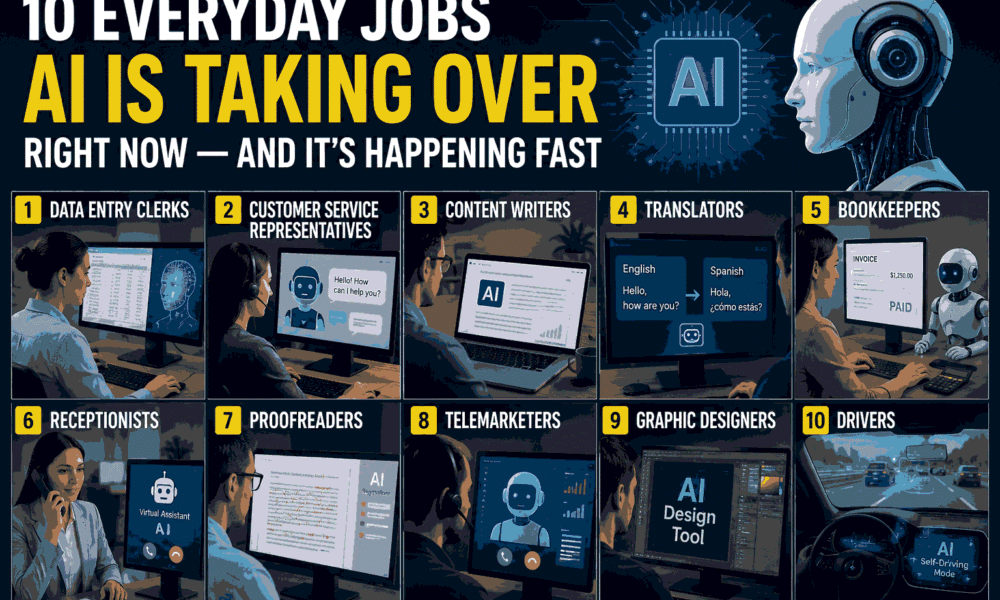
Table Of Content
- 1. Customer Service AI Representatives
- 2. Data Entry Ai Clerks
- 3. Paralegals and Legal Assistants
- 4. AI Radiologists and Medical Imaging Analysts
- 5. AI Journalists and Content Writers
- 6. Truck Drivers and Delivery Drivers
- 7. Bank Tellers and Loan Officers
- 8. Graphic Designers (Entry to Mid-Level)
- 9. Translators and Interpreters
- 10. Administrative Assistants and Office Coordinators
- So, What Happens Now?
Nobody’s coming to warn you. The shift is already here.
Ten years ago, people laughed at the idea that a machine could write a news article, hold a customer service conversation, or diagnose a medical image. Today, all three are happening — at massive scale, around the clock, without a coffee break or a paycheck.
The uncomfortable truth? AI isn’t some distant threat on the horizon. It’s not a Silicon Valley talking point or a sci-fi fantasy. It’s a business decision being made in boardrooms across America right now, and it is actively reshaping the job market in ways that millions of workers are only beginning to feel.
This isn’t about robots on an assembly line. This is about white-collar jobs, knowledge work, and the kinds of careers people spent four years and $80,000 in student loans preparing for.
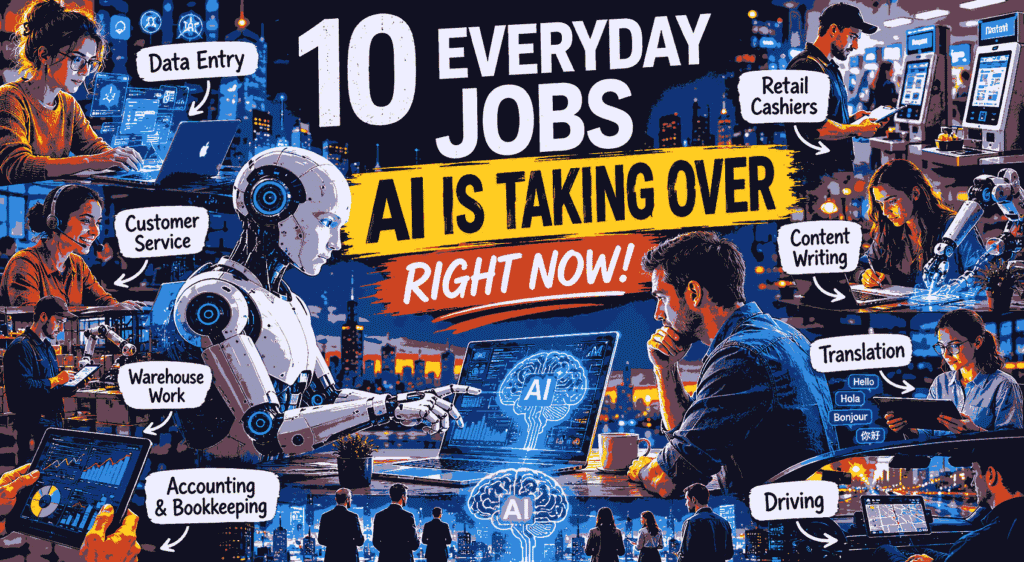
Here are 10 everyday jobs AI is taking over in real time and why it’s moving faster than anyone expected.
1. Customer Service AI Representatives
This one hit first, and it hit hard. AI-powered chatbots and virtual agents can now handle thousands of customer inquiries simultaneously — returning items, tracking packages, resetting passwords, answering billing questions — without a hold time or a script error.
Companies like Amazon, Bank of America, and Delta Airlines have deployed AI chat systems that resolve the majority of customer issues before a human ever gets involved. What used to require a team of 50 support agents in a call center can now be handled by a single AI system running 24/7.
The Bureau of Labor Statistics projects a 5% decline in customer service jobs through 2032. For a field that employs over 3 million Americans, that’s a staggering number of displaced workers.
2. Data Entry Ai Clerks
If your job involves moving information from one place to another — typing, copying, organizing, or updating records — AI has already replaced you in many industries, and it’s coming for the rest.
Intelligent document processing tools can extract data from invoices, contracts, and forms at speeds no human can match, with error rates approaching zero. Healthcare systems, insurance companies, and logistics firms are automating entire data entry departments. This isn’t a future threat. Entire roles have already been eliminated.
3. Paralegals and Legal Assistants
Law was supposed to be safe. It’s not.
AI tools like Harvey, CoCounsel, and Lexis+ AI can now review thousands of legal documents in hours, summarize case law, draft standard contracts, flag compliance issues, and conduct legal research that would take a junior associate days to complete.
Major law firms are already reducing their paralegal and legal assistant headcount as AI handles the document-heavy, time-intensive work that used to justify those entry-level legal positions. The ladder into law just got a lot harder to climb.
4. AI Radiologists and Medical Imaging Analysts
This one surprises people — because medicine feels untouchable. But AI is proving remarkably accurate at reading X-rays, MRIs, and CT scans, in some studies outperforming human radiologists at detecting early-stage cancers and abnormalities.
Companies like Google DeepMind and Enlitic have built AI systems that analyze medical images with speed and consistency no human team can replicate. Radiologists aren’t gone yet, but the demand for the role is shifting rapidly — and medical schools are already seeing declining interest in the specialty.
5. AI Journalists and Content Writers
You’re reading a human-written article right now. Enjoy it — because a growing portion of what you read online is not.
AI-generated content is flooding the internet at a scale that would have been unimaginable five years ago. Sports recaps, financial summaries, real estate listings, weather reports, product descriptions, and local news briefs are increasingly written by AI at major outlets including the Associated Press, Bloomberg, and dozens of regional news organizations.
For freelance writers and entry-level content roles, the market has already tightened dramatically. Rates have dropped. Jobs have disappeared. The middle of the content economy is hollowing out fast.
6. Truck Drivers and Delivery Drivers
With an estimated 3.5 million truck drivers in the United States, this is one of the most consequential AI disruptions playing out in slow motion — until suddenly it won’t be slow at all.
Companies like Waymo Via, Aurora, and TuSimple have been running autonomous freight trucks on American highways for years. Regulatory hurdles remain, but the technology works. When those hurdles clear, the economics are undeniable: an autonomous truck doesn’t sleep, doesn’t need breaks, doesn’t file overtime, and never gets distracted.
Last-mile delivery drones from Amazon and Wing are already delivering packages in parts of Texas, Arizona, and several other states. The disruption isn’t coming. It’s here — and it’s scaling.
7. Bank Tellers and Loan Officers
ATMs replaced a generation of bank tellers. AI is finishing the job.
AI-powered lending platforms can now evaluate loan applications, assess credit risk, verify documents, and issue approvals in minutes — a process that used to take human loan officers days. JPMorgan Chase, Wells Fargo, and other major institutions are using AI underwriting tools that have dramatically reduced the need for human decision-makers in standard lending scenarios.
Bank branches are closing across the country. The teller role, once a stable entry point into financial services, is approaching obsolescence.
8. Graphic Designers (Entry to Mid-Level)
Tools like Midjourney, Adobe Firefly, DALL·E, and Canva’s AI suite have changed what’s possible for non-designers. Marketing teams that once relied on freelance graphic designers for social media graphics, ad creatives, and basic branding assets are now producing that content in-house with AI tools — faster, cheaper, and at scale.
Senior designers with strategic vision and client relationship skills are still in high demand. But the bottom of the design market — the entry-level work that used to build careers — has been largely automated away.
Read More: Ai is taking our job, Here is how
9. Translators and Interpreters
Google Translate was a novelty. DeepL, GPT-4, and modern neural translation models are something else entirely.
AI translation tools now produce output that professional translators describe as genuinely difficult to distinguish from human work, especially for common language pairs like Spanish-English, French-English, and German-English. Agencies are cutting translator rosters. Rates for standard document translation have collapsed.
Niche, high-stakes interpretation — courtrooms, medical settings, live diplomatic negotiations — still requires humans. But the volume work that sustained thousands of translation professionals has evaporated.
10. Administrative Assistants and Office Coordinators
Scheduling meetings. Booking travel. Preparing reports. Answering emails. Organizing files. These are the core tasks of millions of administrative professionals across America — and AI handles all of them now.
Tools like Microsoft Copilot, Google Workspace AI, and dedicated executive AI assistants can manage calendars, draft correspondence, summarize documents, and coordinate logistics without human intervention. Companies are quietly not replacing administrative staff when they leave — because the AI already handles the workload.
So, What Happens Now?
Here’s the thing nobody wants to say out loud: not every job is coming back.
Some of the roles on this list will be partially automated — humans working alongside AI in hybrid models. Others are being eliminated entirely, and the people who held them will need to pivot, retrain, and reskill for a labor market that is changing faster than any workforce transition in modern history.
The workers who will thrive in the next decade are those who embrace AI as a tool rather than fear it as a threat — the ones who learn how to use it, work alongside it, and develop the irreplaceable human skills it still cannot replicate: empathy, creativity, strategic judgment, and trust.
The shift is happening. The only question is whether you’re ahead of it — or behind it.
The time to decide is now.
Don’t Forget : The AI That Knows What You’ll Do Before You Do It
Keywords: jobs AI is replacing 2025, artificial intelligence job displacement, AI taking over jobs, automation and unemployment, future of work AI, jobs lost to AI, AI disruption workforce, white collar AI replacement






No Comment! Be the first one.