

The Truth About iPhone and Samsung in 2026 : Most Buyers Get It Wrong
While mobile phones undoubtedly provide countless benefits and conveniences, their excessive and improper use brings with it a variety of negative effects and challenges that are often overlooked.

Table Of Content
- For years, the battle between Apple Inc.’s iPhones and Samsung Electronics Galaxy phones has divided smartphone users around the world. In 2026, the competition is fiercer than ever. Both companies are pushing AI-powered features, advanced cameras, longer battery life, and smarter ecosystems. But despite all the hype, most buyers are still making the wrong choice, not because one brand is bad, but because they buy based on myths rather than real-life needs.
- The Biggest Myth: “iPhone Is Better for Everyone”
- Samsung Quietly Won the Hardware War
- Why iPhone Still Dominates in America
- The Real Winner in 2026: AI Features
- Camera Truth: Social Media Changed Everything
- Battery Life and Charging: Samsung Has the Edge
- The Hidden Problem With Buying Phones in 2026
- Foldables Are Changing the Industry
- So Which One Should You Buy?
For years, the battle between Apple Inc.’s iPhones and Samsung Electronics Galaxy phones has divided smartphone users around the world. In 2026, the competition is fiercer than ever. Both companies are pushing AI-powered features, advanced cameras, longer battery life, and smarter ecosystems. But despite all the hype, most buyers are still making the wrong choice, not because one brand is bad, but because they buy based on myths rather than real-life needs.
If you’re planning to upgrade your phone this year, this guide breaks down the truth about iPhones and Samsung phones in 2026. No fanboy arguments. No marketing nonsense. Just what actually matters.
The Biggest Myth: “iPhone Is Better for Everyone”
One of the most common beliefs in America is that the iPhone is automatically the “best” smartphone. That idea has been reinforced for years through social media, celebrity culture, and Apple’s premium branding.
But in 2026, that’s no longer universally true.
Yes, the latest Apple iPhone 18 Pro is incredibly powerful. It delivers smooth performance, outstanding video recording, tight security, and one of the strongest app ecosystems in the world. Apple’s software optimization is still elite.
However, many buyers pay over $1,200 for an iPhone and only use it for texting, TikTok, YouTube, and Instagram. Most people never use even half of the device’s actual power.
Meanwhile, Samsung’s flagship devices now offer features many users have wanted for years: faster charging, better multitasking, advanced AI customization, higher zoom capabilities, and more display freedom.
The truth is simple: the “best phone” depends on how you actually use your device.
Samsung Quietly Won the Hardware War
In 2026, Samsung is dominating smartphone hardware innovation.
The latest Samsung Galaxy S26 Ultra has one of the brightest and smartest displays ever created. Samsung continues to lead in screen technology, battery improvements, and camera zoom capabilities.
While Apple focuses heavily on stability and refinement, Samsung keeps experimenting with futuristic features:
- AI-powered photo editing
- Real-time call translation
- Desktop-style multitasking
- Advanced foldable technology
- Customizable lock screens and widgets
- Ultra-fast charging
For power users, Samsung phones often feel years ahead.
This is especially true for content creators, gamers, and business users who multitask heavily. Samsung gives users more control, more customization, and more flexibility.
That doesn’t mean Samsung is perfect. Some users still find One UI overwhelming compared to Apple’s clean simplicity. But Samsung has dramatically improved software stability over the past few years.
Why iPhone Still Dominates in America
Even though Samsung has incredible hardware, Apple still controls the cultural conversation in the United States.
Why?
Because Apple sells an ecosystem — not just a phone.
If you already own a MacBook Pro, Apple Watch Series 12, AirPods Pro, or iPad Pro, the iPhone becomes extremely convenient.
Everything syncs instantly:
- Messages
- Photos
- Passwords
- Notes
- Calls
- Files
- AirDrop transfers
Apple’s ecosystem creates a seamless experience that keeps people loyal for years.
For many Americans, convenience matters more than technical specs. That’s why iPhones continue to dominate among teens, creators, professionals, and influencers.
The Real Winner in 2026: AI Features
The biggest smartphone battle in 2026 is no longer about cameras or processors.
It’s about AI.
Both Apple and Samsung are aggressively integrating artificial intelligence into everyday smartphone use.
Samsung currently feels more aggressive with AI tools. Galaxy AI can:
- Summarize notes instantly
- Translate phone calls in real time
- Rewrite emails
- Edit photos with generative AI
- Organize schedules automatically
Apple, on the other hand, focuses more on privacy-centered AI. Its AI tools are deeply integrated but often more controlled and less experimental.
This creates a major difference:
- Samsung feels futuristic
- Apple feels polished and safe
Many buyers choose based on personality without realizing it.
If you love experimenting with new features, Samsung may feel exciting. If you want everything to “just work,” Apple remains extremely strong.
Camera Truth: Social Media Changed Everything
Here’s something most people don’t realize:
The best camera is no longer the one with the highest megapixels.
In 2026, social media optimization matters more than raw camera specs.
Apple still dominates video consistency. iPhones produce reliable, natural-looking video for TikTok, YouTube Shorts, and Instagram Reels. Skin tones usually look realistic, stabilization is excellent, and apps are heavily optimized for iOS.
That’s why so many creators still prefer iPhones.
Samsung cameras, however, are now incredibly competitive. The Galaxy S26 Ultra offers insane zoom capabilities, sharper detail, and stronger flexibility for photography enthusiasts.
The difference comes down to your priorities:
- iPhone = simpler, consistent social content
- Samsung = more creative freedom and camera control
Most casual users honestly won’t notice a major difference anymore.
Battery Life and Charging: Samsung Has the Edge
This is one area where Samsung often wins clearly.
Samsung phones generally charge faster and offer more battery flexibility. Many Galaxy users can recharge large portions of battery life in under 30 minutes.
Apple still prioritizes battery longevity and optimization over ultra-fast charging speeds.
For travelers, gamers, and heavy users, Samsung’s charging advantage can genuinely matter.
However, iPhones usually maintain strong battery health longer over multiple years due to Apple’s tight hardware-software integration.
Again, neither is universally “better.” It depends on how you use your phone daily.
The Hidden Problem With Buying Phones in 2026
Most buyers focus on features they’ll never use.
People compare:
- Zoom numbers
- Benchmark scores
- AI buzzwords
- Refresh rates
- Chip names
But the real questions should be:
- Do you want simplicity or customization?
- Do you already use Apple products?
- Do you game heavily?
- Do you edit videos?
- Do you care about privacy?
- Do you upgrade every year or every five years?
These answers matter far more than marketing specs.
A $500 phone in 2026 can already handle most daily tasks extremely well. The smartphone industry has matured. Incremental improvements are now replacing revolutionary jumps.
That’s why many buyers regret spending over $1,000 on features they barely notice.
Foldables Are Changing the Industry
Samsung deserves major credit here.
While Apple still moves cautiously, Samsung has pushed foldable phones into the mainstream. Devices like the Samsung Galaxy Z Fold 8 and Samsung Galaxy Z Flip 8 are far more polished than earlier generations.
Foldables are no longer gimmicks.
Many professionals now use them as mini-tablets for multitasking, reading, gaming, and productivity. Younger users also love the futuristic feel.
Apple is rumored to be preparing foldable devices, but Samsung currently leads this category by experience.
So Which One Should You Buy?
Here’s the honest answer most tech influencers avoid:
Buy the phone that matches your lifestyle — not internet hype.
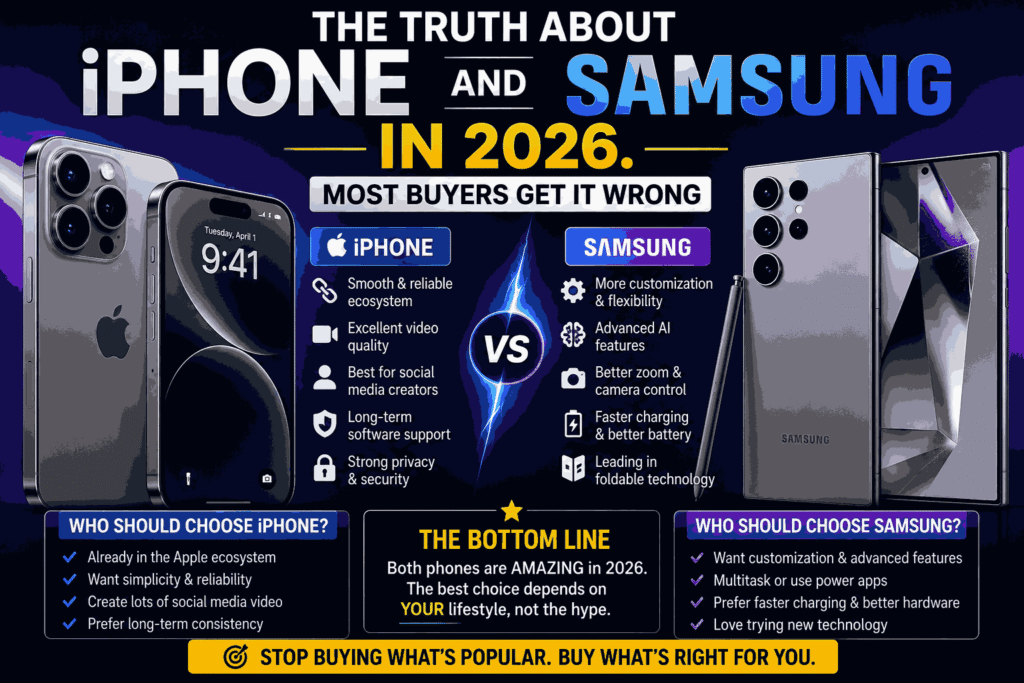
Choose iPhone if you:
- Already use Apple products
- Want simplicity and reliability
- Create lots of social media video
- Prefer long-term software consistency
- Care deeply about privacy and ecosystem integration
Choose Samsung if you:
- Want customization and flexibility
- Love advanced hardware features
- Multitask heavily
- Prefer faster charging
- Enjoy experimenting with AI tools and new technology
Neither brand is objectively perfect.
The truth about iPhone and Samsung in 2026 is that both are incredibly good — so good, in fact, that most buyers overthink the decision.
Instead of asking which phone is “best,” ask which phone fits your actual daily life.
That’s the part most buyers still get wrong.



No Comment! Be the first one.